



Manual vs Automatic vs CVT: The Three Transmission Types Explained
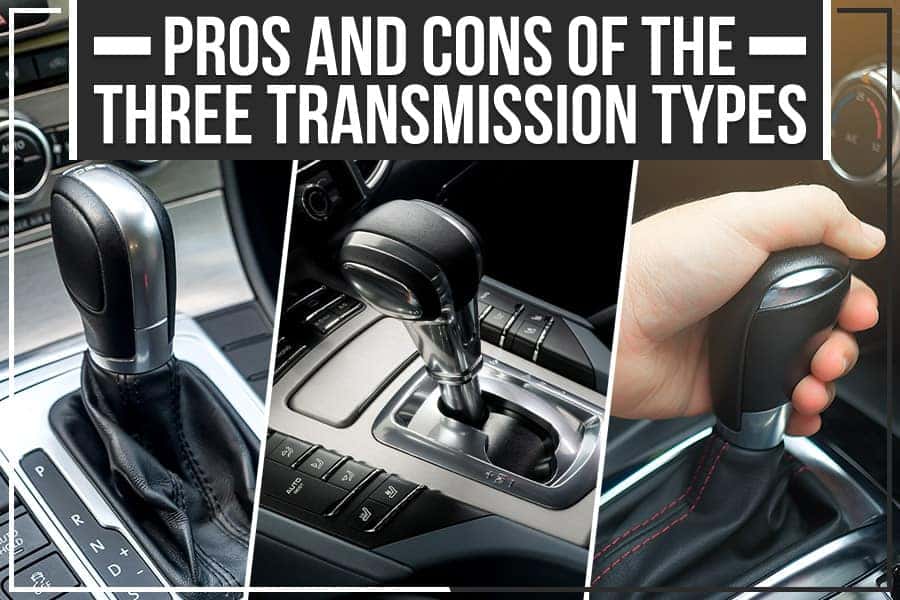
Your transmission decides how engine power reaches the wheels, and it shapes how a car feels more than almost any other component. There are three types in common use: manual, conventional automatic, and continuously variable, better known as a CVT. Below is a straight comparison of all three, what each one is good at, where each one falls short, and which type you will find in a Mazda.
Quick Answer: What Are the Three Types of Transmission?
The three transmission types are manual, automatic, and continuously variable (CVT). A manual transmission uses a clutch pedal and a gear lever, so the driver selects every gear. An automatic transmission shifts through a fixed set of gears on its own, using a torque converter instead of a clutch pedal. A CVT uses a belt and pulley system with no fixed gear steps, which lets the engine hold its most efficient speed. Mazda builds manual and SKYACTIV-Drive automatic transmissions rather than belt-driven CVTs.
Manual vs Automatic vs CVT Compared
The table below sets the three types against the criteria drivers ask about most.
| Manual | Automatic | CVT | |
|---|---|---|---|
| How it shifts | Driver selects gears with a clutch and lever | Shifts through fixed gears automatically | No fixed gears, ratio varies continuously |
| Driver control | Highest | Moderate, most offer a manual mode | Lowest |
| Ease in traffic | Demanding, constant clutch work | Easy | Easiest |
| Fuel economy | Competitive but no longer the leader | Strong, modern units have 6 to 10 gears | Often the strongest in city driving |
| Driving feel | Direct and engaging | Familiar, distinct shift steps | Smooth, engine note can drone |
| Typical maintenance | Clutch wears and is a replaceable item | Fluid service at set intervals | Fluid service, belt is not owner serviceable |
| Availability today | Rare, mostly sports cars | The default in most vehicles | Common in compact cars and crossovers |
| Found in a Mazda | Yes, on the MX-5 Miata | Yes, SKYACTIV-Drive across the lineup | No belt-type CVT; the CX-50 Hybrid uses a hybrid eCVT |
What Is a Manual Transmission?
A manual transmission gives the driver direct control of gear selection. You press a clutch pedal to disconnect the engine from the gearbox, move the lever into the gear you want, and release the clutch to reconnect. Manuals have been in production since the earliest years of the automobile and remain the simplest of the three designs mechanically.
Manual Transmission Pros
- Full control over which gear the car is in at any moment.
- Direct mechanical connection between engine and wheels, which is why enthusiasts prefer it.
- Fewer components than an automatic and no torque converter.
- The clutch is a wearing part that can be replaced without touching the gearbox itself.
Manual Transmission Cons
- There is a real learning curve, and stop-and-go traffic is tiring.
- The fuel economy advantage manuals once held has largely disappeared. Modern automatics with six or more gears frequently match or beat manual EPA ratings.
- Availability is limited. Very few new vehicles still offer one.
- Resale demand is narrower because fewer buyers can drive one.
What Is an Automatic Transmission?
A conventional automatic shifts through a fixed set of gears without driver input. Instead of a clutch pedal it uses a torque converter, a fluid coupling that lets the engine keep running while the vehicle is stopped. Automatics are the most common transmission in vehicles sold in the United States, and modern units have moved from three or four gears to six, eight, or more. If you want to know what each position on the shifter means, see our guide to automatic gear shift letters.
Automatic Transmission Pros
- Easy to drive, particularly in traffic and on long trips.
- Modern multi-gear automatics deliver strong fuel economy and smooth acceleration.
- Most offer a manual or sport mode with paddle shifters when you want more control.
- Broadest availability across every vehicle segment.
Automatic Transmission Cons
- More complex internally than a manual, with more parts that can require service.
- Less direct feel than a manual, though the gap has narrowed considerably.
- Transmission fluid service intervals matter, and skipping them shortens the unit’s life.
What Is a CVT?
A continuously variable transmission has no fixed gears at all. It uses a belt or chain running between two adjustable pulleys, which lets the drive ratio change smoothly across an infinite range. That means the engine can sit at its most efficient speed instead of stepping up and down through gears, which is why CVTs post strong city fuel economy numbers.
CVT Pros
- Excellent fuel efficiency, especially in stop-and-go city driving.
- Completely smooth power delivery with no shift interruption.
- Fewer moving parts than a conventional automatic.
CVT Cons
- The engine note can hold at one pitch under acceleration, which many drivers describe as droning.
- The absence of shift steps feels disconnected to drivers who want a sporting response.
- The belt and pulley assembly is not owner serviceable, and fluid requirements are specific to the unit.
Which Transmission Type Is Best for You?
There is no universally correct answer. Match the transmission to how you actually drive.
Choose a manual if driving engagement is the point, you enjoy shifting for its own sake, and your commute is not dominated by heavy traffic.
Choose an automatic if you want the broadest model choice, easy daily driving, and modern fuel economy without giving up the option of shifting yourself when the mood strikes.
Choose a CVT if maximum city fuel economy is your top priority and you are untroubled by the way it sounds under hard acceleration.
Which Transmission Does Mazda Use?
Mazda builds its own automatic transmissions under the SKYACTIV-Drive name and does not fit conventional belt-and-pulley CVTs to its gas-powered vehicles. SKYACTIV-Drive was engineered to combine the efficiency of a CVT with the direct, stepped response of a conventional automatic, which is why Mazda vehicles tend to feel more connected than segment rivals that use a CVT.
If you want a manual, the MX-5 Miata is the model to look at. Mazda has kept a six-speed manual available on the Miata and it remains one of the very few new vehicles in the United States still offered that way.
Across the SUV range, the CX-30, CX-5, CX-50, CX-70, and CX-90 use Mazda-built automatic transmissions with fixed gear steps. Mazda’s electrified models, the CX-50 Hybrid, CX-70 Plug-In Hybrid, and CX-90 Plug-In Hybrid, take two different routes. The CX-70 and CX-90 plug-in hybrids pair a stepped automatic with an electric motor. The CX-50 Hybrid uses a hybrid system developed with Toyota and an electronically controlled CVT (eCVT), which blends engine and electric motor power through a planetary gearset rather than a belt and pulleys.
Frequently Asked Questions About Transmission Types
What are the three types of transmission?
The three types are manual, automatic, and continuously variable (CVT). A manual uses a clutch pedal and gear lever and the driver selects each gear. An automatic shifts through fixed gears on its own using a torque converter. A CVT has no fixed gears and varies its ratio continuously using a belt and pulley system.
Is a manual or automatic transmission better on fuel?
Automatics generally match or beat manuals on fuel economy today. Manuals held a real advantage when automatics had three or four gears, but modern automatics with six to ten gears and lock-up torque converters closed that gap. Compare the EPA ratings for the specific model and engine you are considering rather than assuming one type wins.
Does Mazda use CVT transmissions?
Not in its gas-powered models. Mazda uses its own SKYACTIV-Drive automatic transmissions rather than belt-and-pulley CVTs. SKYACTIV-Drive was designed to deliver CVT-level efficiency while keeping the direct, stepped shift feel of a conventional automatic. The exception is the CX-50 Hybrid, which uses a Toyota-developed hybrid system with an electronically controlled CVT (eCVT).
Which Mazda models come with a manual transmission?
The MX-5 Miata is the Mazda most associated with a manual gearbox and has kept one available while most of the market moved away from it. Manual availability changes by model year and trim, so check current listings or contact our sales team at 850-863-8380 to confirm what is on the lot right now.
Is a CVT worse than a regular automatic?
It is a different set of trade-offs rather than a worse transmission. A CVT typically delivers better city fuel economy and completely smooth power delivery. A conventional automatic gives more familiar shift steps and a more responsive feel under hard acceleration. Which one suits you depends on whether efficiency or driving feel matters more.
How do I know which transmission my car has?
Check the window sticker, the owner’s manual, or the build details for your VIN. A clutch pedal to the left of the brake means a manual. If there are only two pedals, look for a gear count in the specifications. A transmission listed without a gear count is often a CVT.
Does transmission type affect maintenance?
Yes. A manual has a clutch that wears and is eventually replaced. An automatic and a CVT both depend on transmission fluid condition and have service intervals set by the manufacturer. Whichever type you drive, following the interval in your owner’s manual matters more than the transmission type itself.
Find Your Next Mazda at Mazda of Fort Walton Beach
Whichever transmission suits how you drive, the best way to judge it is from the driver’s seat. Mazda of Fort Walton Beach is at 785 Beal Pkwy NW, Fort Walton Beach, FL 32547, and our sales team can line up a back to back drive so you can feel the difference for yourself. Browse the current lineup online, then call 850-863-8380 to arrange a test drive.
0 comment(s) so far on Manual vs Automatic vs CVT: The Three Transmission Types Explained